TL;DR
The CLARITY Act cleared the Senate Banking Committee in a 15-9 bipartisan vote, marking the most significant legislative progress on crypto market structure in the US to date.
The SEC is actively working on an innovation exemption to allow tokenized versions of publicly traded stocks to trade on crypto platforms, a sign of how far tokenisation has come at the policy level.
Mastercard received its New York BitLicense, joining Circle, Coinbase, and Paxos as a NYDFS-regulated digital asset operator and signaling serious intent to become core settlement infrastructure.
BlackRock and JPMorgan both filed fund prospectuses within days of each other to compete for stablecoin reserve business created by the GENIUS Act, with both funds Ethereum-based and backed by short-term Treasuries.
The European Commission opened a consultation to review and refine MiCA, the world’s most advanced crypto regulatory framework, a sign of how seriously regulators are taking the space as enforcement ramps up.
All three BitSave products closed May in negative territory. The Bitcoin Product ended at -2.88%, the Crypto & Gold Product at -5.47%, and the Crypto Index Product at -6.25%.
THOUGHTS
Crypto is steadily moving into mainstream policy conversations. Governments and regulators across major markets are now actively designing frameworks for digital assets, treating them as a permanent part of the financial system. May 2026 was defined by a series of important regulatory developments in that direction.
In the United States, the Senate Banking Committee advanced the CLARITY Act on May 14th by a 15-9 vote, a meaningful step toward a clearer market-structure framework for digital assets. The bill now heads to the full Senate floor, where it will need 60 votes to advance. Separately, the SEC was preparing an “innovation exemption” to permit tokenised versions of publicly traded stocks to trade on crypto platforms, a plan it delayed after feedback from exchanges and market participants. The delay is a sign of how much ground tokenisation has covered at the policy level, despite unresolved questions.
In the UAE, Crypto.com became the first virtual asset service provider licensed by the Central Bank of the UAE to accept digital assets for government fee payments, in partnership with the Dubai Department of Finance. Settlements are processed in UAE dirhams or CBUAE-approved stablecoins, anchoring all transactions to regulated currency.
Meanwhile, the European Commission launched a targeted consultation in May to assess whether the Markets in Crypto-Assets regulation remains fit for purpose. The review covers stablecoins, investor protections, and supervisory coordination, suggesting regulators want to refine the rules before full-scale enforcement ramps up. The world’s most advanced crypto rulebook is being stress-tested less than 18 months after coming into force. This is a sign of how quickly the landscape is evolving.
From an India-based perspective, the bigger question is whether the current approach has a shelf life. Crypto profits face a flat 30% tax and a 1% TDS on every transaction, with no comprehensive regulatory framework in place. The recently announced SEBI tokenisation pilot suggests that parts of the Indian establishment see the opportunity in blockchain clearly. The gap is between that recognition and a policy response to match it.
May 2026 underlines one thing: the global momentum around crypto regulation is creating real opportunities to help shape the next layer of financial infrastructure. The groundwork being laid today will matter for a long time.
TOP STORIES
Mastercard Gets NewYork BitLicense
Mastercard’s subsidiary, Mastercard Transaction Services (U.S.) LLC, received its BitLicense from the New York State Department of Financial Services on May 27, clearing the payments giant to operate digital asset activities, specifically stablecoins and tokenized deposits, under one of the strictest crypto regulatory frameworks in the US. That puts Mastercard in a select club of NYDFS-regulated digital asset operators alongside Circle, Coinbase, and Paxos and signals the company is serious about becoming core settlement infrastructure, not just a crypto-friendly card network. This follows Mastercard’s $1.8 billion acquisition agreement for stablecoin payments firm BVNK in March, and comes as rival Visa has already hit a $3.5 billion stablecoin settlement run rate across 40+ countries.
CLARITY Act Clears Senate Banking Committee
The Digital Asset Market Clarity Act passed the Senate Banking Committee in a 15-9 bipartisan vote on May 14, advancing the crypto industry’s primary legislative goal in Washington to the next stage. The bill lays out a broad market structure framework covering DeFi regulation, tokenization standards, stablecoin yield limits, developer protections, and customer-property and bankruptcy protections.The next stop is the full Senate floor vote. After years of stalls and restarts, US crypto finally has a regulatory framework in motion.
BlackRock and JPMorgan Are Racing to Own Stablecoin Reserve Infrastructure
The GENIUS Act created a new market by allowing stablecoin issuers to hold tokenised money market funds as reserves and within days of each other, BlackRock and JPMorgan both filed prospectuses to compete for it. Both funds are Ethereum-based, backed by short-term Treasuries and cash, and restricted to whitelisted wallets.
SEBI Pilots Blockchain Tokenisation of Corporate Bonds, Warns of Quantum Computing Risks
India’s market regulator SEBI has launched a pilot project for blockchain-based tokenisation of corporate bonds, aiming to improve efficiency, transparency, and accessibility in debt markets. While pushing this innovation, SEBI has flagged quantum computing as a significant emerging risk that could potentially compromise the cryptographic security underlying blockchain systems.
BIS Project Agorá Completes Prototype Phase
The Bank for International Settlements (BIS) has successfully concluded the prototype phase of Project Agorá, a major initiative exploring tokenised assets and programmable money for cross-border payments. Eight central banks are now progressing to the next stage, which involves real-value testing aimed at enhancing the speed, cost-efficiency, and transparency of international transactions.
BITCOIN ANALYSIS
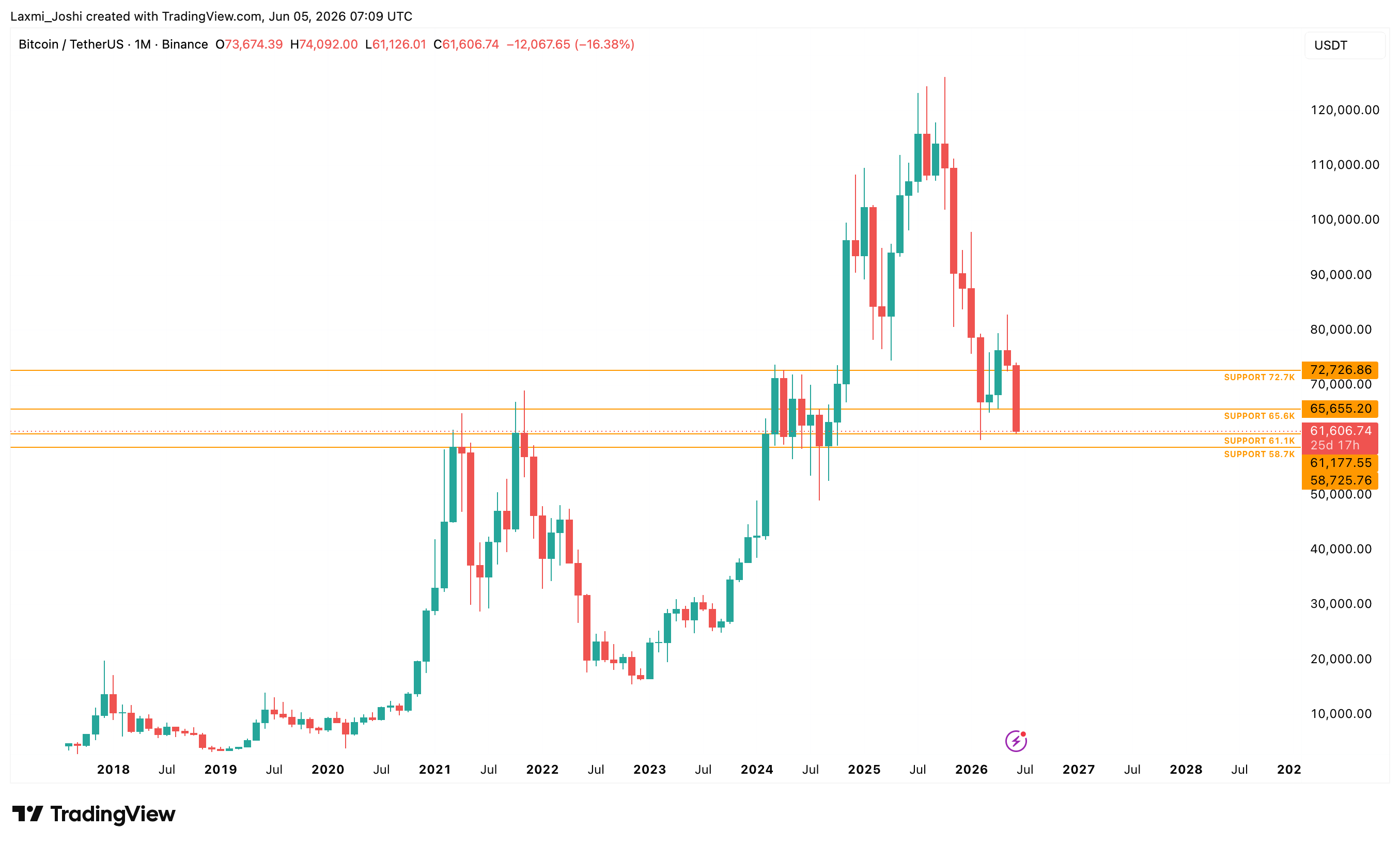
Bitcoin’s key support level in the $72,000 range and $65,000 range has been broken. The next major support zone is at around $61,000, which has held up well in previous tests, and then at around $58,000 level.
CRYPTO MARKET PERFORMANCE
MAY 2026
MAY 2026
PRODUCT PERFORMANCE
MAY 2026
MAY 2026
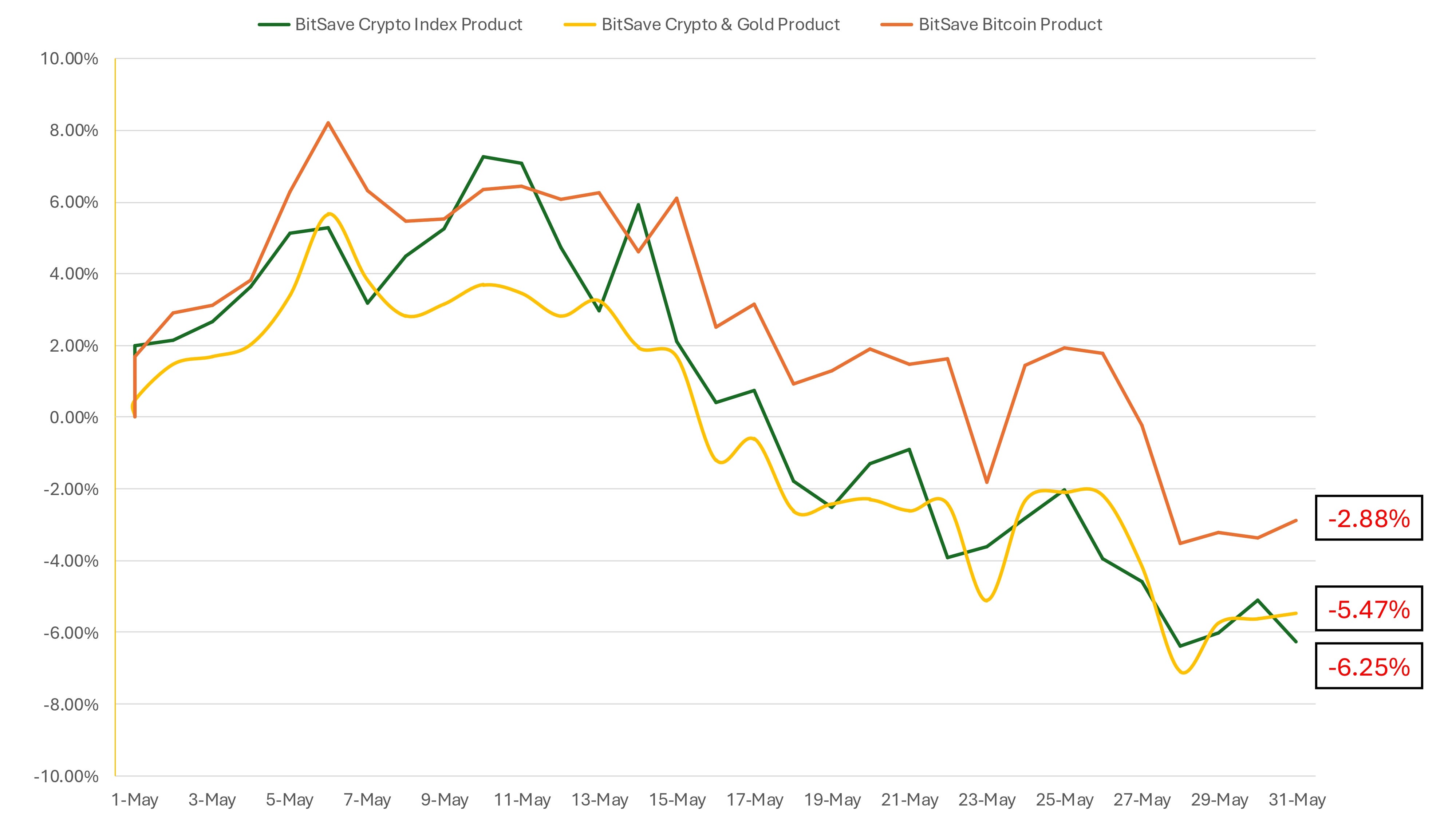
All three products started May on a positive note, with the Bitcoin Product leading early gains and peaking near +8% around May 6–7. However, the momentum reversed sharply from mid-month, with a broad sell-off dragging all products into negative territory by month-end.
BLOOMBERG GALAXY CRYPTO INDEX (BGCI)
JUNE 2026
JUNE 2026