


Bitcoin is currently in the late $60k’s. It is down about 44% from the peak and is currently in a downtrend. So why is Bitcoin behaving this way? The answer is it has always behaved this way. This is a normal bear market correction of a young, 17 year old, volatile asset.
Lets start with the technical analysis aspect of it.
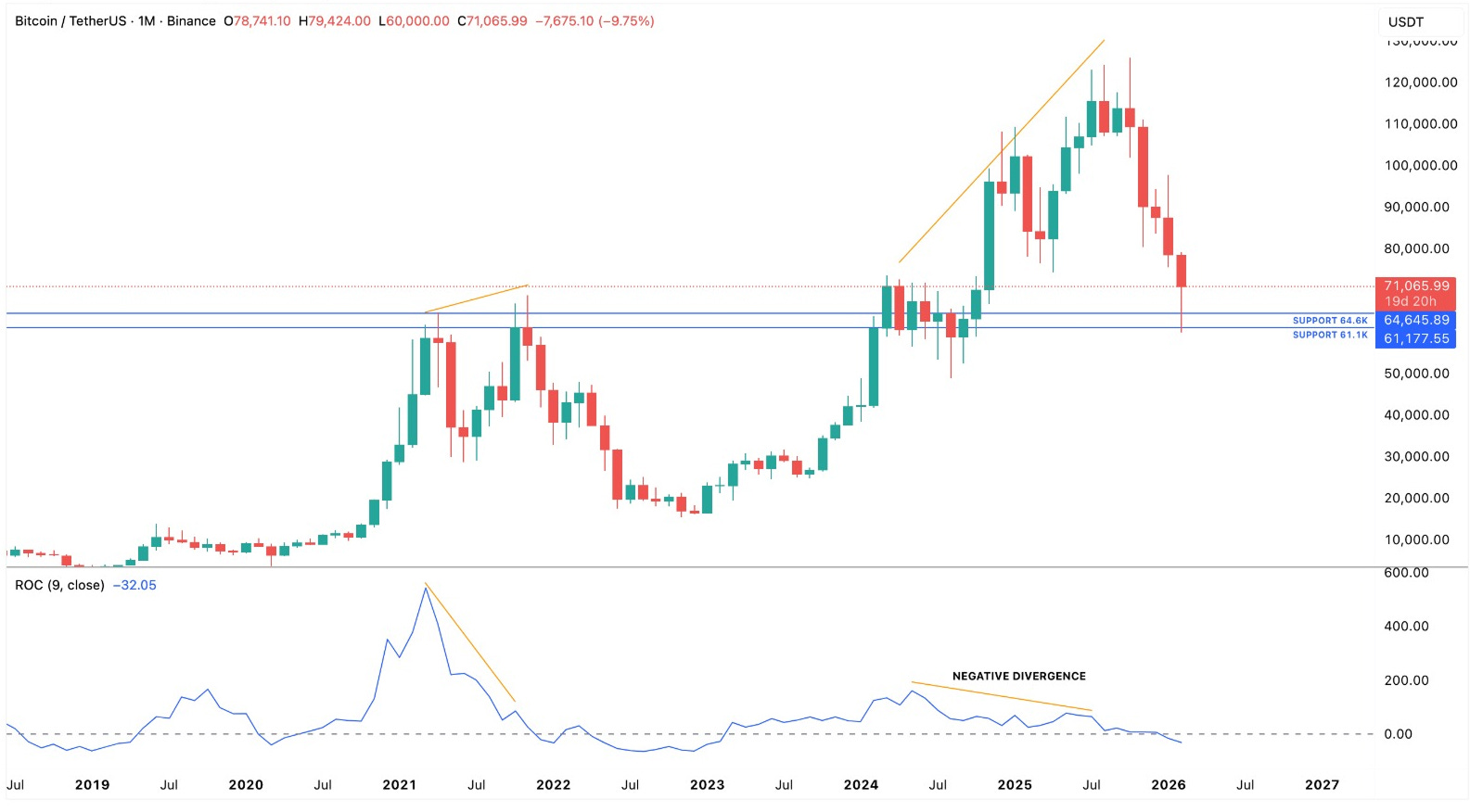
Even though Bitcoin was in an uptrend, that is making higher highs and higher lows consistently, the momentum indicator started showing negative divergence, i.e., as price made a new high, the momentum indicator (Rate of Change-ROC) failed to make a new high. This is shown in the image with the downward sloping line in the ROC indicator. Momentum precedes price action and hence divergences are warnings of reversal. They don’t mean price is going to come crashing down immediately but are early warnings. The general expectation - given the inflows in ETFs and Bitcoin Treasury Companies, adoption by US banks and other global institutions - was that Bitcoin will touch $150-200k before a correction but the correction came sooner than expected.
Bitcoin is currently in a downtrend, marked by lower lows and lower highs. This doesn’t mean its the end of Bitcoin as we know it. It will find support at some level, and a good one is placed at $61,000. Price tested that support and bounced up from there and is currently at around $71,000.
What’s the sentiment among the masses?
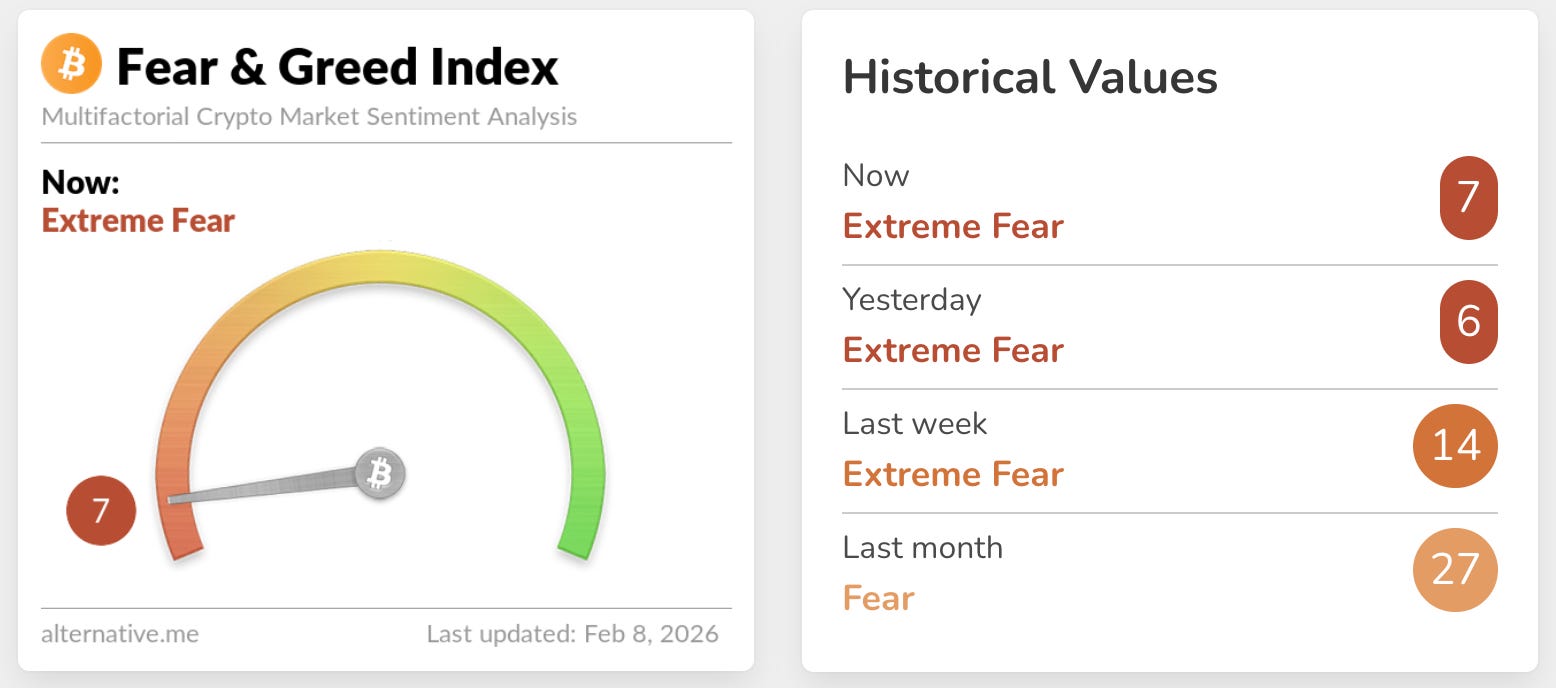
Periods of Fear and Extreme Fear on the Crypto Fear & Greed Index typically reflect widespread market panic, capitulation, and heavy selling pressure, which often push Bitcoin and other fundamentally strong crypto assets to temporarily undervalued price levels relative to their long-term potential.
Historically, these low-sentiment phases have repeatedly acted as attractive entry points because they coincide with reduced speculation, shaken-out retail, and prices that later prove to be significant discounts when adoption, network growth, and fundamentals eventually reassert themselves.
Have the fundamentals changed?
Bitcoin’s price remains volatile. Its fundamentals do not.
At its core, Bitcoin is a globally accessible, 24x7, publicly verifiable network with a hard-coded and finite supply of 21 million. These bitcoins are divisible, portable, and fungible, and are secured by an open global community, with no board, CEO, or central authority that can alter the rules or switch the system on/off.
Bitcoin issuance follows a transparent and predictable schedule. New bitcoins are generated (or technically, mined) every ~10 minutes. Crucially, the rate of new issuance is cut by 50% every ~4 years, an event known as the Halving.
This schedule runs uninterrupted, irrespective of public holidays, market conditions, or external events.
In 2009, 50 bitcoins were generated every 10 minutes.
In 2012, this reduced to 25.
In 2016, to 12.5.
In 2020, to 6.25.
Following the April 2024 halving, new issuance stands at 3.125 bitcoins.
As a result, nearly 20/21 million bitcoins have already been issued. Yet, because issuance continues to halve every 4 years, the last & final bitcoin is expected to be mined only around the year 2140, over a 124 years from now!
This reduction in new supply occurs irrespective of price, market sentiment, schedules, or macroeconomic conditions.
In a world where central banks expand money (and thereby, credit) in response to economic stress, Bitcoin’s monetary policy moves in the opposite direction. Supply growth slows, predictably and permanently. Scarcity increases with time.
The network itself remains live, global, and publicly verifiable at all times. The same rules that governed Bitcoin in 2009 continue to govern it today. What changes is not the rules of the game, but how the world chooses to value it.
Bitcoin’s security is reinforced by the largest pool of distributed computational power ever dedicated to a single network. Since its launch in 2009, the Bitcoin blockchain itself has not been compromised. The network has continued to operate continuously for over 15 years, settling transactions globally without a central operator or control point.
These are not new narratives. They are Bitcoin’s core design principles, and they remain firmly intact.
What does Bitcoin’s adoption trajectory look like over the past 5 months from the start of the downtrend till now. Lets look at some of the headlines.
Bank of America starts allowing its wealth advisors to recommend crypto allocation to clients
Morgan Stanley filed to launch Bitcoin and Crypto ETFs
Vanguard Flips Pro-Bitcoin, Enables ETF Access
UK Recognises Digital Assets as Property
Harvard to allocate Bitcoin 2-to-1 Over Gold
JPMorgan Explores Institutional Crypto Trading
Binance Makes Massive Bitcoin Purchase in Bold Market Move
Strategy Capital Loads Up on Bitcoin in Major Treasury Allocation
Deutsche Bank envisages Central Banks holding Bitcoin alongside Gold, by 2030.
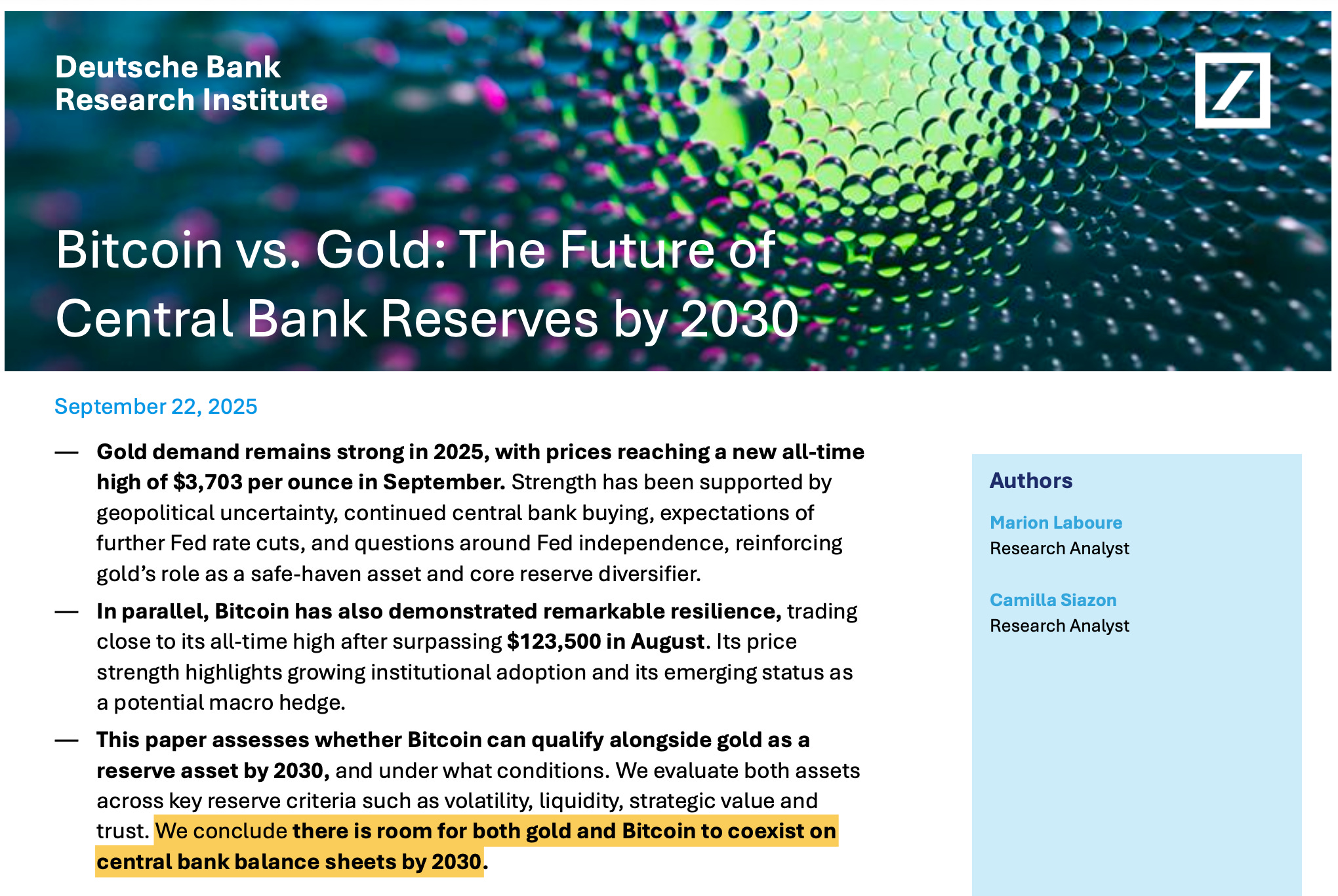
Thus, institutional participation remains the dominant structural force in crypto markets in 2026, even during periods of price weakness or consolidation.
To summarise, Bitcoin is currently technically weak but remains fundamentally strong as always, and one that is increasingly being adopted by countries, institutions and corporations.